In the Lab: Where the Real Work Happens
I'm an undergraduate researcher in the Dempsey Lab at UNC Chapel Hill, where my work focuses on electrochemical CO2 reduction, specifically the immobilization of molecular catalysts on hydrogen-terminated silicon electrodes.
This summer I'm conducting full-time research through UNC's Summer Undergraduate Research Fellowship (SURF), diving deeper into the intersection of electrochemistry and renewable energy.
My broader research interests are expanding toward chemical biology and drug-facilitating work. Always curious, always growing.
Previous experience includes: NSF plastic degradation and organic synthesis research, mathematical biology research, and an undergraduate learning assistantship work supporting students in general and organic chemistry.
Featured Projects
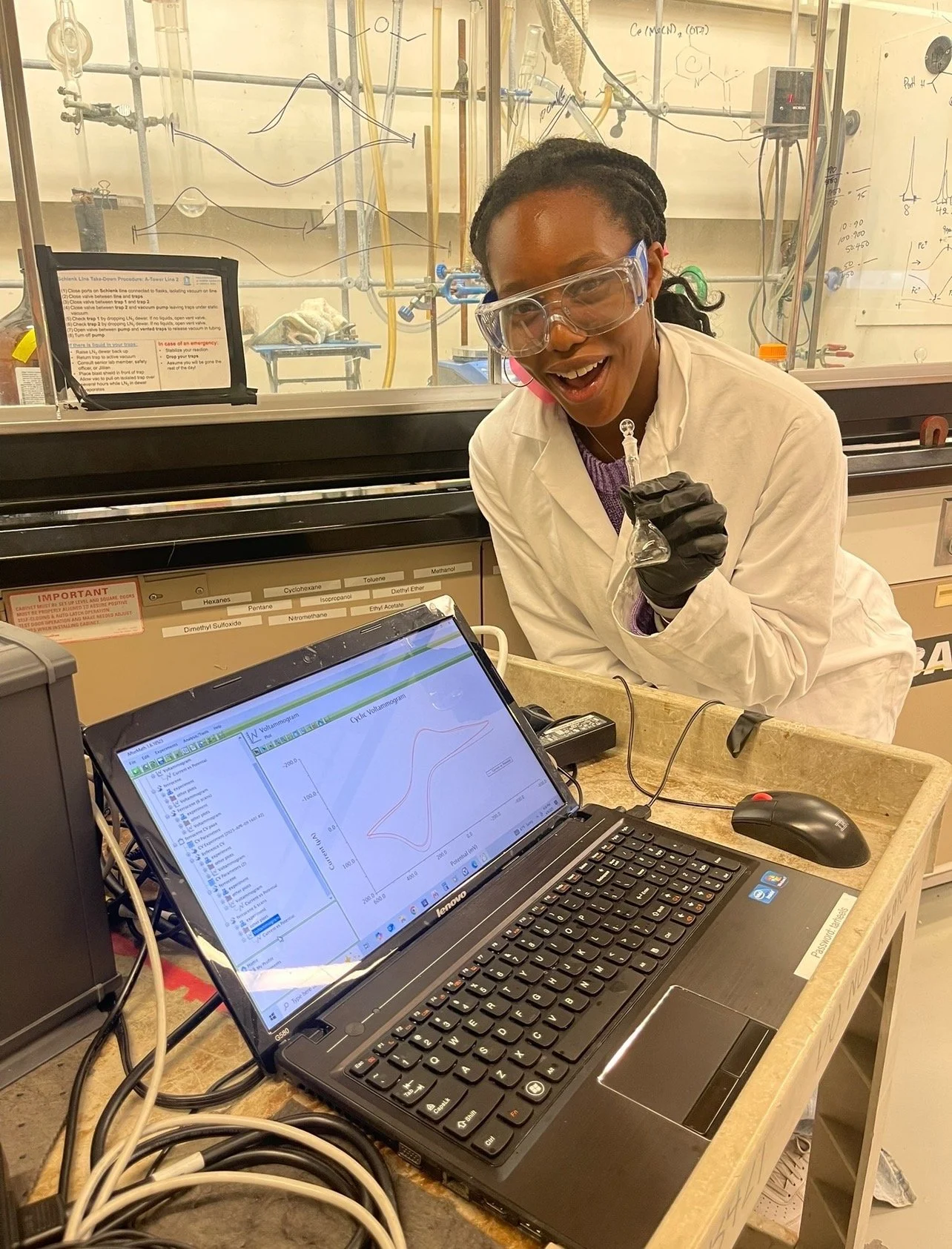
Photoelectrochemical Characterization of Hybrid p-Si/SiOₓ Electrodes for CO₂ Reduction — Electrochemical Research, Dempsey Lab, UNC Chapel Hill
One of the biggest challenges of our time is figuring out what to do with excess carbon dioxide in our atmosphere. My SURF research tackles this from a chemistry angle, specifically, how we can use electron transfer to convert CO2 into useful products rather than letting it accumulate as a greenhouse gas.
I work on immobilizing molecular catalysts onto hydrogen-terminated silicon electrodes, essentially building tiny chemical systems that can drive this conversion efficiently. The goal is to better understand how these catalysts behave when anchored to a surface, which is a key step toward developing scalable, clean energy solutions.
This project sits at the intersection of electrochemistry, materials science, and sustainability. And it's teaching me that the most important scientific questions are rarely simple ones.
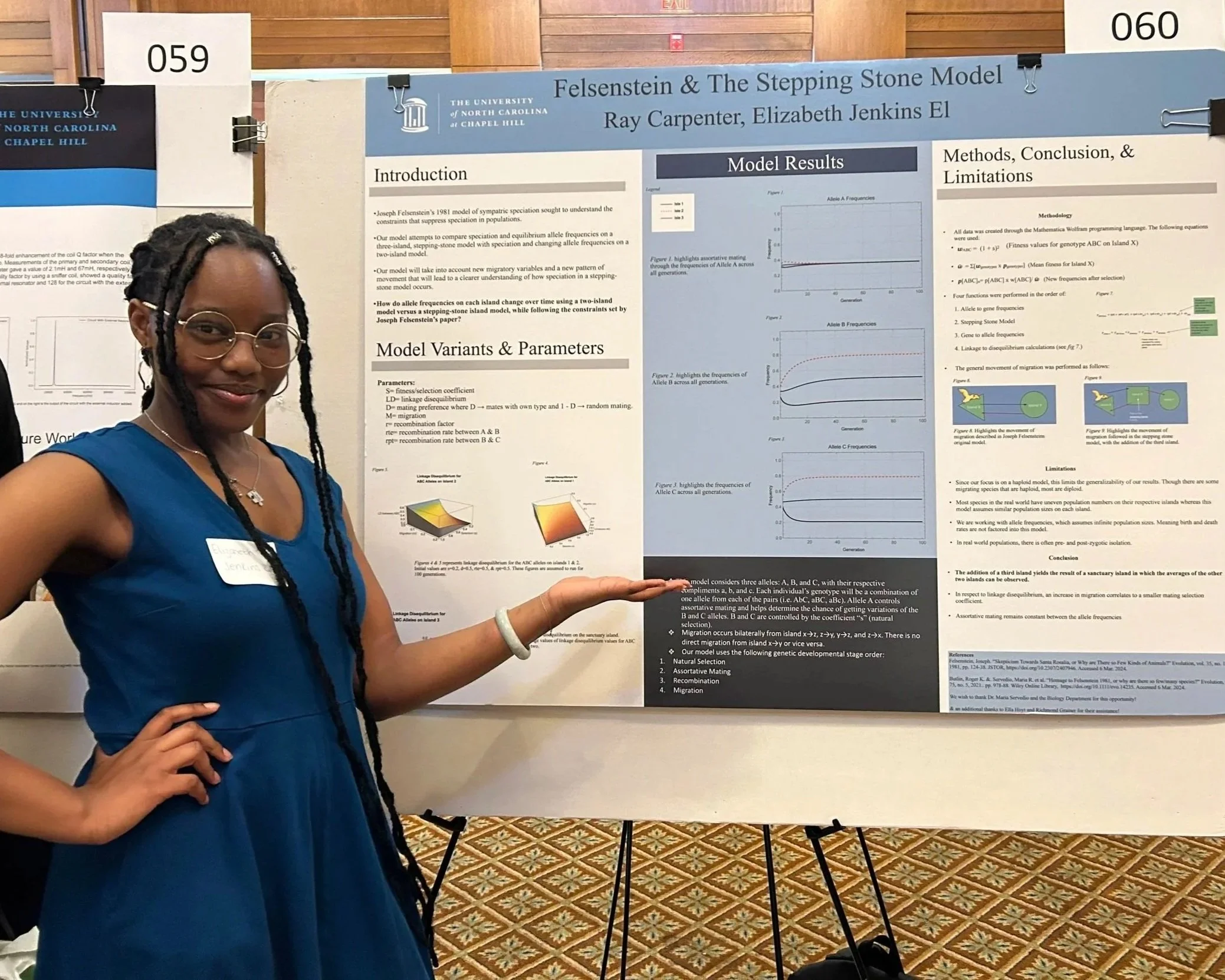
Felsenstein & the Stepping Stone Model —Mathematical Biology Research, UNC Chapel Hill
Biologist Joseph Felsenstein asked a deceptively simple question in 1981: if species can evolve so easily, why aren't there infinitely many of them? His work pointed to recombination and natural selection as the main barriers to speciation in wild populations.
I took his classic two-island model one step further. What happens when you add a third island? Using a stepping stone model, I tracked how allele frequencies and linkage disequilibrium shift across three populations over time and compared those results to what Felsenstein originally found.
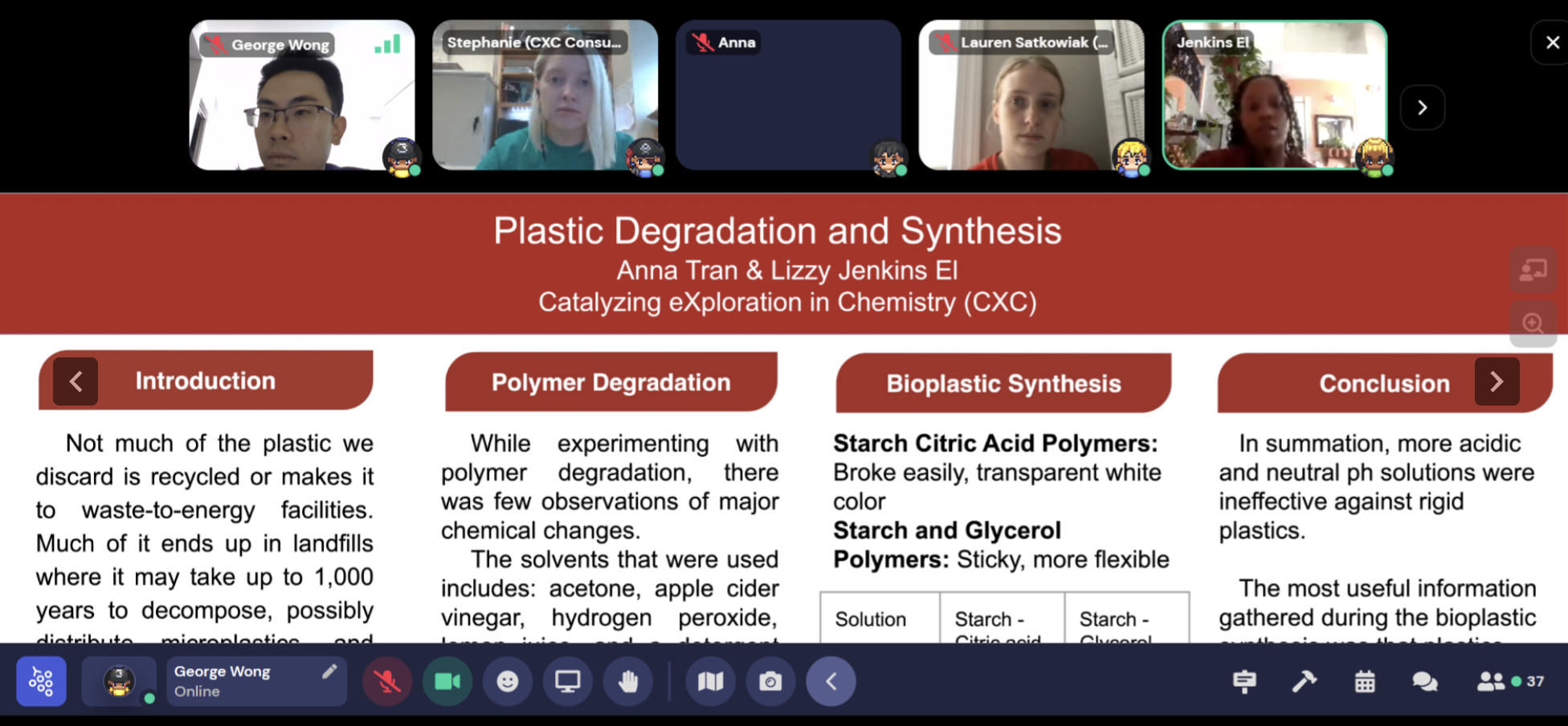
Plastic degradation and bioplastic synthesis — National Science Foundation (NSF)
A research experience through Catalyzing eXploration in Chemistry (CXC), focused on plastic degradation and bioplastic synthesis. The project investigated the resistance of common plastics to degradation using solvents including acetone, apple cider vinegar, hydrogen peroxide, and lemon juice, finding that more acidic and neutral pH solutions were ineffective against rigid plastics. The second component explored bioplastic synthesis, comparing starch-citric acid polymers and starch-glycerol polymers in terms of flexibility, transparency, and structural integrity. Findings were presented virtually at a research symposium, contributing to broader conversations around sustainable materials and plastic alternatives.
“Science and everyday life cannot and should not be separated.”
“Not everything that is faced can be changed, but nothing can be changed until it is faced”
“Trust me, there is a light at the end of the tunnel”
Awards & Milestones:
Carolina Scholar: merit-based scholarship recognizing academic excellence at UNC
Spectrum Scholar: awarded to students committed to diversity and inclusion in STEM
Equitable Excellence Scholar: recognizing students advancing equity in their communities
Accelerated Research Scholar: awarded to undergraduate researchers making early research contributions
Honors Carolina Student: UNC's honors program for high-achieving and intellectually curious students
SURF 2026: competitive fellowship funding for full-time summer undergraduate research
UNC Undergraduate Research Symposium, Spring 2024: presented original mathematical biology research to the UNC community
UNC Undergraduate Research Symposium, Spring 2027 (upcoming): will present electrochemical CO2 reduction research